Most website audits die in a doc. Someone runs the audit, the findings get written up, the doc gets shared in a channel, three people leave a thumbs-up, and two months later nothing has shipped. We've watched this happen enough times to be fairly sure the problem isn't the audit. It's what happens after — or doesn't.
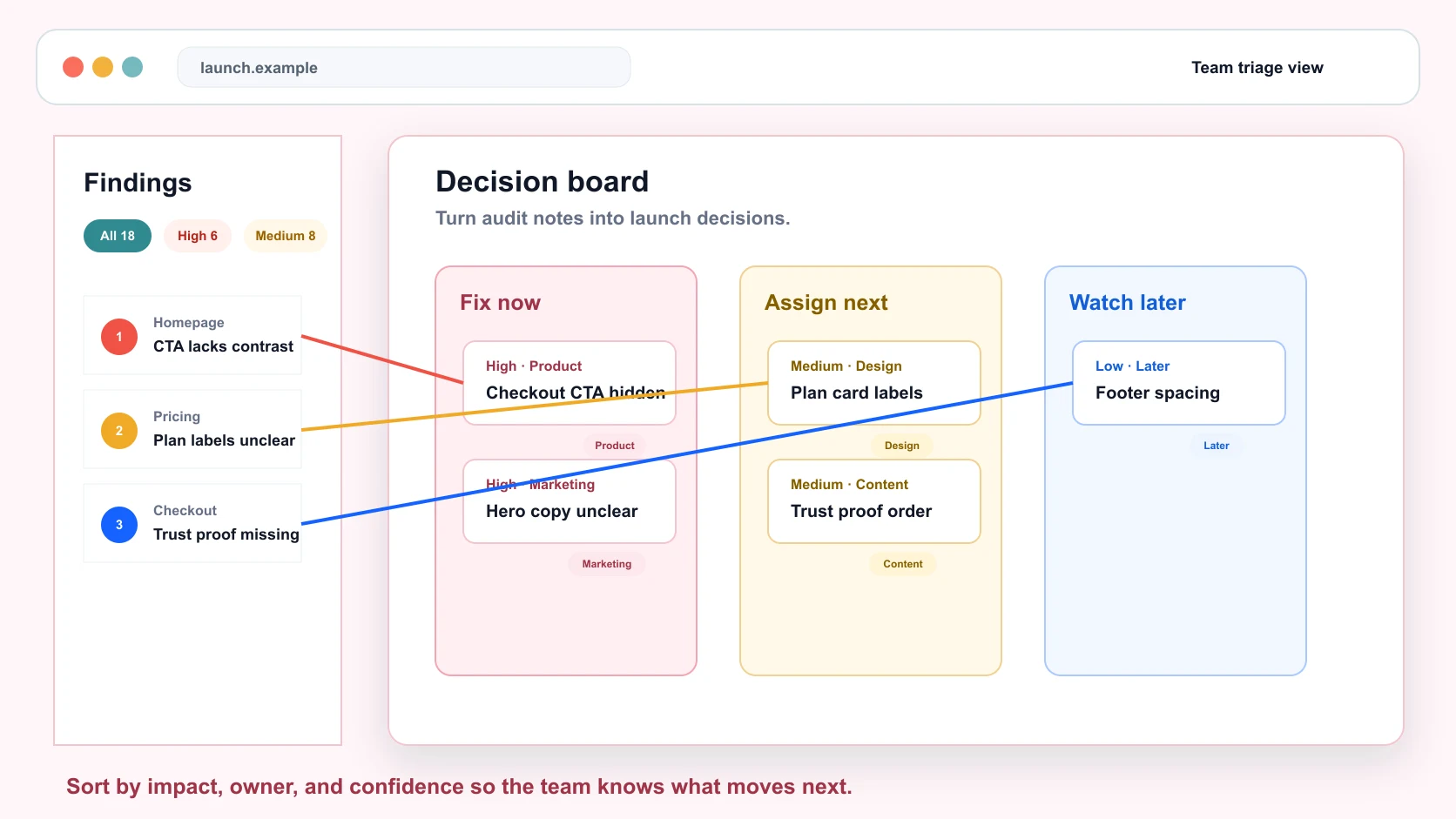
Triage is the missing step. Here's a version that works for small product and marketing teams and fits in one 30-minute meeting.
Why findings don't turn into fixes
Three patterns show up over and over.
Forty findings, all the same size. When everything arrives at equal weight, it reads as "everything is wrong", and the brain rounds that down to "nothing is actionable".
No owner. The homepage belongs to product, marketing, and design at the same time — which in practice means it belongs to no one.
Notes nobody can locate. "The pricing section is confusing." Which part? On mobile? In what state? Every vague note costs a few minutes of archaeology before anyone can even discuss it.
Step 1: Sort by impact on users. Ignore effort.
Effort comes later. Sort by effort first and the easy cosmetic stuff wins while the hard important stuff gets a backlog ticket that never moves.
Three buckets are enough:
- Blocks people — visitors can't tell what the product is, can't find or finish the main action, or hit an accessibility wall.
- Slows people down — the task works, but it's harder than it should be. Unclear labels, weak contrast, cramped mobile layouts.
- Polish — rough edges that dent the quality impression but don't change what people do.
Be stingy with the first bucket. If half your findings are "blocking", either the site is genuinely in trouble or your bar is too low. Both are worth finding out.
Audit tools help with the initial sort — Snap Site tags findings high, medium, or low out of the gate — but overrule the tool freely. It doesn't know which page your ad spend lands on this month. You do.
Step 2: One owner per finding
Not one person to do the work. One person accountable for the finding either shipping or being consciously declined.
The split is usually natural. Product takes workflow and feature-comprehension issues. Marketing takes messaging, trust signals, and anything tied to campaigns. Design takes hierarchy, interaction, and the structural accessibility problems. Engineering gets pulled in per finding.
"Declined — that whole section gets replaced next quarter" is a perfectly good outcome, by the way. It's a decision. That's the point.
Step 3: Now, next, or later — said out loud
For each finding in the top two buckets, the owner picks one: now (this week or this sprint), next (scheduled, with a date), or later (parked).
Two rules keep this honest. Nothing from the blocking bucket gets parked unless the group agrees on the reason. And "later" needs a trigger — a date, a release, the next audit. Later without a trigger is just "never" with better manners.
Keep the evidence on screen
The triage meetings that drag are the ones where people spend time reconstructing what each note meant. The ones that move are the ones where every finding is pinned to a screenshot of the exact state it describes. Nobody asks "where is this?" or "was that on mobile?" — the capture answers it.
That's the main reason Snap Site pins findings to captured pages instead of exporting a report: the discussion and the evidence stay on one surface. You can also share the audit as a link, so product, marketing, and design are looking at the same capture instead of three different live versions of the page.
The 30-minute agenda
- 0–5 min: whoever ran the audit shows what was captured — which pages, which screen sizes, anything odd about the run. No findings yet.
- 5–15 min: blocking findings, one at a time. Confirm severity, name an owner, call now/next/later.
- 15–25 min: friction findings. Same drill, faster. Batch the related ones.
- 25–30 min: skim the polish bucket. Owners claim anything they want to fold into existing work; the rest waits for the next pass.
Then write the decisions back onto the findings themselves. Mark things solved as they ship. Note what was declined and why. Next time you audit the same pages, you compare against this run — and you can actually see whether the work mattered.